Output formats
extract(..., output_format=...) renders the same extraction in seven formats, with trafilatura's own renderers.
>>> import etrafilatura as trafilatura
>>> html = """<html><head><title>Small tools win</title></head><body><article><h1>Small tools win</h1>
... <p>A tool that does one job is cheap to audit, cheap to replace, and composes with the rest through plain text.</p>
... <p>Platforms accumulate switching costs until leaving them costs more than staying; small tools never do.</p>
... <blockquote>Write programs that do one thing and do it well.</blockquote>
... <ul><li>grep searches</li><li>sort orders</li></ul></article></body></html>"""
>>> print(trafilatura.extract(html, output_format="xml"))  # doctest: +ELLIPSIS
<doc fingerprint="...">
  <main>
    <head rend="h1">Small tools win</head>
    <p>A tool that does one job is cheap to audit, cheap to replace, and composes with the rest through plain text.</p>
    <p>Platforms accumulate switching costs until leaving them costs more than staying; small tools never do.</p>
    <quote>Write programs that do one thing and do it well.</quote>
    <list rend="ul">
      <item>grep searches</item>
      <item>sort orders</item>
    </list>
  </main>
  <comments/>
</doc>
>>> print(trafilatura.extract(html, output_format="html"))
<html>
  <body>
    <h1>Small tools win</h1>
    <p>A tool that does one job is cheap to audit, cheap to replace, and composes with the rest through plain text.</p>
    <p>Platforms accumulate switching costs until leaving them costs more than staying; small tools never do.</p>
    <blockquote>Write programs that do one thing and do it well.</blockquote>
    <ul>
      <li>grep searches</li>
      <li>sort orders</li>
    </ul>
  </body>
</html>
>>> import json
>>> sorted(json.loads(trafilatura.extract(html, output_format="json")))
['comments', 'text']
| Format | Returns | Notes |
|---|---|---|
txt (default) |
Main text, then comments | with_metadata=True prepends a YAML header |
markdown |
Main text as Markdown | Formatting implied |
xml |
<doc>: metadata attributes, <main>, <comments> |
trafilatura's vocabulary: head, quote, list/item, table/row/cell, hi, ref |
xmltei |
A TEI document | tei_validation=True validates against trafilatura's tei_corpus.dtd |
json |
text, comments and, with metadata, every Document field |
ensure_ascii=False |
csv |
One tab-separated row: url, id, fingerprint, hostname, title, image, date, text, comments, license, pagetype | |
html |
A self-contained HTML document | <meta> head with with_metadata=True |
The renderers are trafilatura's code, vendored verbatim; what can still differ is the content the engine selects → Compatibility.
Fidelity
make fidelity runs the fixture corpus (tests/resources/html/: six synthetic pages, PEP 8 and a Wikipedia
article) through etrafilatura and Python trafilatura and scores, per page:
| Metric | Measures |
|---|---|
exact:<format> |
Share of pages whose output is byte-identical, for each of the seven formats |
format:txt, format:markdown |
Word-token similarity; blind to whitespace and markup; a None on one side only scores 0 |
metadata |
Share of equal fields among title, author, date, sitename, url, hostname, categories, tags, pagetype |
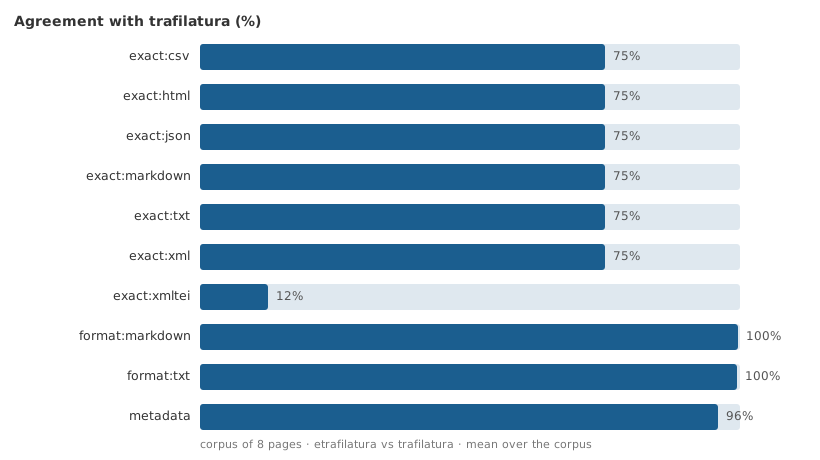
The mean over the corpus is committed in fidelity.json; a drop beyond the tolerance fails the
check, and make fidelity ARGS=--update rewrites it. The six synthetic pages are identical in every format except
where Compatibility says otherwise; the two real pages differ by the engine's content
selection.